Thursday, September 18, 2008

Earth Democracy


Justice, Sustainability, And Peace. Vandana Shiva believes that peasants should be able to make a living based on access to land, rivers, forests and oceans and that governments must protect the health of these commons for the good of all. This makes her a radical. She also makes complete sense and answers many of my questions about the inequity of the poor.

Much of this book is a discussion of the commons and the enclosure laws in England in the 16th century that allowed the commons to be privatized. Critics of Vandana Shiva claim that she is asking for a return to feudalism, but they are not hearing her out. (And besides feudalism guaranteed that the peasants would eat, while privatization guarantees that those without money will starve while taking away access to the land that originally provided them with a livelihood.) Much of the battle of the enclosure laws is waged with words. By claiming that an area of land is a wasteland and is not being used by anyone, this somehow gives private companies the right to buy the land or contract to use it for development purposes.

She ferrets out the flaws in the arguments of the opposition ie Richard Epstein in his book "Takings—Private Property and the Power of Eminent Domain". Their position is that government cannot protect natural resources like beaches, streams and other property because it would be a "taking" and therefore the owners must be compensated. This argument, she says, ignores the original taking of these public lands during colonialism, but it also confuses public trust with eminent domain which is virtually the opposite. And finally the public is redefined as a collection of individuals thus the loss of property is calculated based on its higher value to one individual vs each member of the public. Here she has not only explained how things have changed, but what kinds of arguments have influenced far reaching policies and how we have been manipulated into buying into the ideology of privatization over public interests. This is an important concept because it is a cultural battle of words that over time has eliminated the very notion of a public trust. If it were not still going on, this book would just be a historical treatise, but with water rights and clean air and the earth's atmosphere at stake, her arguments serve as the ground floor of resistance.

She also debunks the argument that having a commons doesn't work because everyone will abuse it. Not so, she says, as long as everyone can subsist off the land and be self-reliant, the community will work together to insure that no one party takes advantage. Assumptions are being made by free market advocates that have messed with our minds, but her examples show a different picture.

She points out the correlation between economic livelihood and the attraction of fundamentalism both here and abroad. When people no longer have a livelihood to identify with and globalization forces upon them a cultural sameness, they are attracted to religion and will vote for issues relating to cultural identity rather than economic identity. This explains why Gay Marriage has the ridiculous political status as a hot button issue when there is so much else at stake.

She claims that when enclosure laws allow people a living only by selling their labor (and their bodies I would add) then that encourages a population increase as families feel they need to have more children to bring in more income or to insure that at least one survives to care for them in old age since more die.

Her discussion includes the enclosure of intellectual and biological property with Monsanto trying to patent seed species. While governments pass laws that forbid farmers from participating in trade as they have always done, ie: saving their own seeds to sell to other farmers. She explains how governments help out large companies by passing laws inappropriate to small producers, for whom complying to these laws, would put them out of business, ie food packaging laws under the guise of safety. Thus her alliance with Slow Food Nation (she is Vice President) to support local foods and small producers.

She talks about how the sustenance economy is not valued on the market because it does not involve paid labor ie;, women's work, home economics, child rearing. Yet such work is how the recognized market can exist. She warns that the market is bent on the exploitation of resources that support the sustenance economy such as clean water, air and land and comments that the only sustainable economy is the sustenance economy because of its built-in feed back loops and community. The market however tends to solve problems by providing solutions of increasing complexity involving more exploitation of resources and more privatization as seen with privatization of water.

Getting inside Vandana Shiva's worldview stretches my head, but I really think she gets to the root of global issues and successfully relates how economic justice is the road to democracy and in turn to peace. She is apparently a huge threat to advocates of individualistic wealth building systems, thus the caustic negative reviews of her work as extremely leftist. The rich don't like being told that their success comes at great cost to the poor rather than out of their own smarts. But If we could embrace what she is saying, solving our most destructive planetary problems may look a lot simpler.

Labels: , , , ,

Wednesday, July 16, 2008

Stuffed & Starved


Raj Patel is much sought after these days since the rise in the price of food worldwide. In his book he attempts to explain the world food system in the tradition of Frances Moore Lappe's Food First and Diet for a Small Planet. I already know quite a bit about the system so there wasn't too much that was new to me in his account. Some explanations stand out. The Hourglass Figure he describes, with accompanying charts, is a good visual image for how money is made in the food system at the point where it is processed by large scale mechanization owned by a few mega corporations like Nestles. These companies process flour for tortillas, beans for coffee, rice when its milled and soybean crushing, for example and cause bottlenecks that jack the price up because only a few players can process food on large scale to meet demand.

He also describes how, historically, the food system was developed to feed those working in the newly industrialized urban areas. The point was to keep this cheap labor from revolting by feeding them cheaply at the expense of the farmers. Our food system technologies came about because of the needs of war, he explains, in that food had to be preserved for transportation under adverse conditions, plus the surplus created by government subsidizing the war effort in food supplies was the beginning of surplus grain being used to manipulate world politics through AID. The whole sociopolitical impact of government policies, AID and trade all play a part in how destructive agribusiness is to life on earth basically. He shows to what lengths Monsanto and company are willing to go to get their way for GMO seeds.

On the other end of the spectrum he talks about how the supermarket was developed to exploit people's impulses to buy. And the inputs in our food that allow it to be transported without damage, but have a huge impact on how crops are used—lecithin for instance. In discussing the obesity epidemic he points out that this is rarely discussed as a symptom of the failures of our food system and poverty, but is blamed on the individual. Obesity patterns in US very similar that of South Africa.

He describes a couple of movements working to change the system including the Landless Rural Movement in Brazil which is a voluntary cooperative system that is democratically run and organized by the farmers trying to occupy land. The details he gives from having visited one of these settlements broadened my understanding of this movement which Noam Chomsky called the world's most important social movement.

He is a fan of the Slow Food movement and farmer's markets, but not organic food in that organic food production as applied to agribusiness is not much different from chemical agribusiness.

In his conclusion he lists 10 ways to change the system

1. Transform our tastes and get away from what commercial food production has taught us to want.
2. Eat locally and seasonally
3. Eat agroecologically meaning eat food produced in harmony with the local environment as developed in Cuba and embraced by Masanobu Fukuoka's One Straw Revolution in Japan as well as the UN developed sustainable agriculture network.
4. Support locally owned business not supermarkets or big box stores. He points out the flaw in corporate responsibility because it hinges on profit being made.
5. All workers have the right to dignity through unions that are allowed to organize without persecution.
6. Profound and comprehensive rural change such as equitable land distribution, but also including education, healthcare and infrastructure.
7. Living wages for all so poor can access food.
8. Support for sustainable architecture of food. Local markets and CSAs.
9. Snapping the food system's bottleneck. Curb power of monopoles through anti-trust laws.
10. Owning and providing restitution for the injustices of the past and present. Forgive debt owed by the Global South to the Global North and start paying back for damage we have done.

Labels: , , , ,

Sunday, May 18, 2008

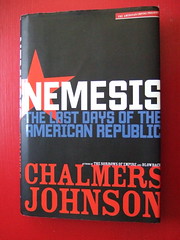
Nemesis—The Last Days of the American Republic


The best summation I've read on the political underpinnings of the fall of Rome, the first republic to suffer collapse due to overstretch. I understood the overstretch part, but I did not understand the role that Cesar played in overextending the empire and the role his nephew Cesar Augustus played in transforming the republic, with its checks and balances that insured democracy, to one of a military dictatorship and to the creation of himself as emperor much as George W. is doing today in the ongoing transformation of our democracy into a military dictatorship and perpetual war-making machine.

He fears that this warmongering will eventually bankrupt us and lead to economic collapse, a very real fear especially since no one has any idea how much money the pentagon is actually sucking up, not to mention the CIA, the president's private army. Our defense industry is shoring up the economy as it is. And with China and Japan lending us money we're relying on the kindness of strangers. The Blanche Dubois economy as one wit put it. Chalmers does not mention that the dollar is used to buy oil, said to be another reason countries honor our worthless dollar.

I was amused to learn in his chapter on space weapons that garbage in space is our chief worry because a piece of junk could knock out all sorts of communications satellites causing misunderstandings about who might have been attacking who by blowing up said satelite. Lot of satellite politics I didn't know about that demonstrate that we really should be devoting ourselves to world cooperation via treaties, as others are doing, rather than world domination with more high tech toys.

Explains how our nefarious activities regarding outsourcing of torture and CIA activity is watched by amateur plane spotters and witnesses in international airports pooling information. This does not endear us to international community.

All this detail did not, however, allow Chalmers to veer from his pet theory that 9/11 was the result of "blowback" from our controlling foreign policies and military colonialism. Despite his bucket-loads of facts, he can give no evidence that Osama Bin Laden did any of the things he is accused of. He simply leaps to conclusions without even bothering to state that he is speculating. He does give ofher evidence of "false flag" operations for the purpose of increasing the military budget.

(Using his facts I was able to feed my own pet theories of the impact of American presence in Thailand. For instance American anti-communist sentiment, he confirms, was expressed in the form of cash gifts (foreign aid) to any country willing to declare that they were carrying out anti-communist projects. Thus I can conclude that the Thai military government received money as a result of establishing policies to encourage the cutting down of the teak forest to "deter" communist insurgents hiding in the jungle. The resulting subsistence farming led to the exodus of farmer's sons to Bangkok to work in construction and their daughters to work in the sex trade (and sometimes visa versa). American service men in Thailand, during the Vietnam War, the existing sex trade grew by four times. (Said sex trade was originally created by the Japanese occupation during WWII.) Since foreign aid from the US is one of the most powerful tools used to manipulate the activities of developing countries, it wouldn't be difficult for the US to put a stop to the sex trade, drug trade, illegal logging, harsh prison conditions for American citizens overseas or any other activity US citizens might wish to put a stop to, but no, we are policing the world for non-humanitarian reasons.)

As Chalmers tells it, the US is interested mostly in establishing US military bases all over the planet in order to control the emergence of any potential super power as has been the agenda of the neo-cons since Reagan. The entire book was very illuminating on this need for relentless control. It is so infuriating to be part of this Darth Vader psychology, much of which has been manifested in policies implemented by the Bush Administration. We are indeed a changed country.

He notes that the number of large and medium size bases (38 in 2005) is just about the number of colonies the British had during the height of the British Empire and is close to the number of bases the Roman Empire had at its height. The US negotiates with the host country to make sure it is not held accountable for anything it or its servicemen do there to local citizens or the environment. This is the source of much contention in the example he gives of Japan, now a crucial base from which to control China. He recommends that the US dismantle the empire as the British did.

Labels: , ,

Friday, February 08, 2008

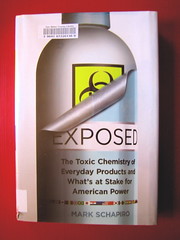
Exposed, The Toxic Chemistry of Everyday Products...


The main treatise of this book is not so much about what's poisoning us in our everyday lives, although that is mentioned, it is that the US no longer controls industry standards because the EU has taken the lead in banishing toxins from multiple industries including electronics, cosmetics, and children's toys as well as banning genetically engineered foods. It has also led the way in demanding that manufacturers take back products at the end of its lifecycle. All this is significant because the EU is also influencing China and India and other emerging economies. This sidestepping of the Bush administration's resistance to change has caused us to remain the guinea pigs for not only our own industry, but also serving as a dumping ground for products that cannot be sold in the EU and other regulated countries.

The book describes the historical precedence that has laid the way for this parting of the ways with the EU. The US chose to monitor dangerous products by allowing citizens to sue for damages when they are hurt by products. This litigious climate of consumer protection is a process that industry has, of course, worked to erode. Meanwhile in Europe, lawsuits were not much tolerated and settlements were small, but citizens had a political climate that demanded that the government protect them from dangerous products in the first place, thus was born the precautionary principle. The difference between the two is that, with the cautionary principle, the burden of proof is on the manufacturer to prove that their product is safe while our approach puts the burden of proof on the consumer to prove that a product is unsafe. In other words our brand of capitalism allowed business to flourish at the risk of consumers while their democracy put citizen safety first and let industry operate within those parameters. (In reality they fight over this just as much as we do, but the base from which they begin is different.)

I also took note that the generic brands are the most likely to fall to the bottom of the regulations heirarchy since the "white box" stores that sell these products always seek the path of least resistance, ie cheapest, easiest to make and least likely to object customer. This is politically interesting because activists are always going after the name brands, but nothing is ever done about the off off off Broadway brands.

The most interesting implication of this shift in power towards the EU is that it has reversed the "race to the bottom" that globalization forced upon us and has used it to leverage up the lax standards of US industry. If this writer had used more inflammatory language such as "race to the bottom" this book would have been much more exciting to read instead of the dry as dust slog it was. I might also add that the implications of this shift points to how free market capitalism is trumped by heavily regulated capitalism (formally socialized democracy). So there.

Labels: , ,

Thursday, November 15, 2007

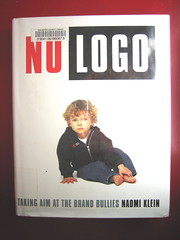
No Logo


I didn't read No Logo when it first came out because I was already a no logo kind of girl. It was worth reading though because she fleshed out the whole sweatshop situation for me. After spending the first few chapters describing how companies have gone from making products to advertising them to branding and now focus only on creating an image, she describes how the whole sweatshop issue is a result of companies getting rid of their own factories and searching for the cheapest labor to assemble their products.

Contractors compete with each other to get those everyday low prices for them. This created what were basically indoor work camps, all over Asia, enclosed in walled compounds that were protected from local taxes in an effort to lure the big name "investors". These "export processing zones" or "free trade zones" are impenetrable to outsiders and short on inspectors. The labor, usually teenage girls and young women, are kept intimidated to discourage labor unions from forming. So what we're talking about here is a structural component of globalization. Countries compete with each other for the big brand name investors so they grant the foreign investor immunity from their own laws regarding minimum wage and conditions, while inspectors turned a blind eye to violations of safety and overtime claiming those to be a management problem. Brand name companies don't have to face the conditions they have created until activists force them to.

Klein asked the same question posed by Travels Of A T-shirt in which the author claims that such factory work is preferable to working on the farm. This was also a statement made by one of the factory owners. The girls are outraged by this assumption and point out that it is just a justification given by those who employ them. One said she missed her family and wished she was at home with them because at least when she was sick there would be someone to take care of her. And they only make enough money to cover expenses so they have little opportunity to either help their family or improve their own lives. Klein gained access to the factories by sneaking into one of the compounds. The author of the t-shirt book was invited into a factory by the owner, so there are factories and there are factories. As I learned from the Green Festival, activists have now established fair trade guidelines and factories that comply to their guidelines can register as a fair trade factory.

Klein also gave me insight into what happened to activism when it got mired in identity politics. She herself was in college fighting for women's rights, gay rights, minority rights, etc. as was I. The problem was that the politics became all about equal representation in the media and equal opportunity for jobs. The equal representation part was co-opted by advertisers looking for niche markets while the equal opportunity for jobs became all about access for middle class women and minorities. Everyone forgot all about the poor and the class system that made sure the poor would remain poor. My complaint was that gay rights had become all about rights for gay people who could present as nearly identical to straight white married upper middle-class people. And women's rights had become all about getting women into the CEO's office while neglecting them at the welfare mom level.

She points out how activists narrowed down their focus, but that there's been a come back as students came to understand that the shirt on their backs was made by their peers in sweatshop conditions and began to protest globalization. Her book predates the WTO protest in Seattle, so she was on the pulse. In the end she acknowledges that there is a limit to activism focused on brand names, while the bigger damage is being done by companies that extract resources and aren't household names.

Labels: ,

Wednesday, November 07, 2007

The Secret History of the American Empire


The fun of reading John Perkins is that his books are more like spy novels than heavy reading about globalization and empire building. So interspersed between exotic descriptions of Asian hotties entertaining corporate hit men, are nice summations of how the IMF, World Bank and economic hit men collude to bring countries into the corporate empire. Basically the same ground as covered in Shock Doctrine, but with more stories of illicit CIA activity.

Often his sources are cloak and dagger in their anonymity. This seems to render him suspect in the eyes of many skeptical readers, but the stories are still compelling and likely true. I mean why wouldn't they be? We now know from recently declassified reports that there was indeed a CIA backed coup to overthrow Allende and then he was assassinated. He describes how a democratically elected leader might be elected based on his promises to help the poor, distribute land and otherwise take resources away from corporations by nationalizing mines, oil reserves, etc,. This is when corporate economic hit men first try to bring around the elected leader with bribes, then when that doesn't work, the CIA jackals threaten him and if that doesn't take, the CIA stage a coup and finally an assassination if he can't be budged.

He also tells the story of a young couple who wanted to find out what life was really like as a sweatshop worker living on $2.41 a day in Indonesia. Conditions described were bordering on destitute so now I'm really mad at the economics professor who wrote Travels of a T-shirt and concluded that these jobs were giving women economic freedom. Besides with the Gap being exposed as an employer of child slave labour, I'm even more inclined to assume that bad conditions and human rights violations are more the rule than the scandalous exception.

There was also another interesting tidbit about OPEC and the gas shortage of the '70s. According to his sources, Nixon was playing a brilliant game of chess by backing Israel in the Six day war which he knew would piss off the Arabs who then raised oil prices. This is interesting in that I've not read anywhere else that pissing off the Arabs was intentional. It was after that that economic hitmen were sent into Saudi Arabia to make a deal for corporations to handle all their infrastructure. US also persuaded them to invest their oil money in American treasury bonds and agree to only sell oil for dollars. Since Nixon took the dollar off the gold standard this gave the dollar an "oil" standard which we are busy trying to protect by going to war in any oil producing country that makes deals to sell oil in Euros. Speculators seem to betting that the Euro will win, given the 40% devaluation of the dollar in recent years.

His stories about Africa tell how NGOs and the Peace Corp are inadvertantly helping corporate takeover, by instilling first world living standards. For the amount of money spent to send over Western "teachers", they could be developing teachers who are already there who know the land already and how to farm it. Instead the Peace Corps teachers are bringing in GMO seeds and pesticides and fertilizers to "help" farmers get into debt and kill off their land.

And finally he talks about how to make change, telling stories of how Rainforest Action Network got their point across through public humiliation of corporations like Home Depot. He emphasizes that even though companies seem so big, so was the English crown to the colonialists. Though it's not my preferred metaphor, he does persuade me to believe that ordinary people can put pressure on corporations.

Labels: , ,

Wednesday, August 22, 2007

The Travels of a T-Shirt In the Global Economy


This is just the kind of non-fiction I like–a journey in search of the truth filled with anecdotes about real people. The author, however, is an economist professor and one who upholds the ideals of the "free market" while acknowledging that one doesn't exist. Her quest is to find out whether the claims of recent student activists about the horrors of sweatshops are really justified.

The long view she offers through history taught me a lot about the influence of the textile industry as the primary driver of the industrial revolution—satanic mills and all that, not to mention driving the slave trade to work the cotton farms to supply those mills in England. Is this not an early example of globalization?

Then there's the history of protectionism which gave me a working knowledge of how politics work in the American congress and the role of the textile industry in the South re: trade and foreign policy. And the role these protectionist policies played in helping industrialize all the little players in all those third world countries that wouldn't have been able to compete with Japan or China, but were given their moment in the market because of US quota systems.

As a good economist would, the author sees this industrialization of all the corners of the world as a leg up out of poverty. She did give me pause in her claim that jobs for women in sweatshops working long hours for little money were an improvement over jobs at home on the farm working even longer hours for no pay under the authority of the family patriarch. We all know about the oppression of women in China, after all, so we'll go along with that.

The history of China's early textile manufacturing serves as an example of sustainable production. The farmers themselves, the entire family, carded the cotton, spun it into yarn and wove it into cloth on their home loom. They made their own clothes from it, then took the rest to market to sell. Her point is that this system created no bottlenecks so no Eli Whitney to invent the cotton gin or whatever was needed to ease those bottle necks, the solving of which would increase production (which would result in increased demand, but she doesn't mention that).

The most fun chapter is about the used clothing market. Unlike e-waste, dumping our used clothing on poor countries around the world isn't toxic. Though the documentary T-shirt Travels claims that such dumping destroys the local clothing industry, she makes the observation that it was already destroyed through mismanagement of the local governments and because socialism didn't work because factories didn't seem to produce and things just didn't get done.

Whenever pro free market writers talk about mismanagement by local governments, I've learned to read that as a sign of lazy thinking. Local governments may be mismanaged and corrupt, but they do not have nearly the power of destruction that large scale economic policies enacted by the World Bank and IMF do. Her anecdotes of the entrepreneurs she meets does convince me that socialism is miserable at providing incentives for workers to produce and innovate, but then she didn't see The Take about the power of democratically run cooperatives to produce for whatever markets they can find usually local.

It's too bad the student activist that inspired her didn't also shout something out about the deterioration of the planet because not once does she mention how industry impacts the earth, polluting it and using up natural resources and she was writing this in 2004, so no excuse.

Labels: , ,

Wednesday, August 15, 2007

The Bush Agenda


Covers much more than just the Bush agenda, going back to the first influence of the Neo-cons with the Carter doctrine drawn up by Paul Wolfowitz. Covers all the usual territory about PNAC (Plan for a New American Century) and how that group first expressed themselves by asking Clinton to go to war with Iraq. Much of this story I already knew; what was illuminating were the details and background on the four companies that are major war profiteers and supporters of Bush's global agenda, namely Halliburton, Chevron, Bechtel and Lockheed Martin. Except for Haliburton, the other three are based in Northern California making it a local story for me. I was particularly illuminated by the history of Bechtel and how George Schultz angled to overthrow US policies that would help his company gain business access to the whole world to build nuclear power plants, thus kicking off the global proliferation of nuclear arms.

My father worked for the defense industry (as an engineer) so reading about Lockheed Martin recalled the work he did and the eagerness with which he wanted us to go to the Persian Gulf war so he could field test the heads-up pilot's helmet for which he was able to patent some solution of his that was crucial to making it work. That I was a peace activist did amuse him so especially because he was so confident that war was inevitable.

The author lays out the history of the oil industry both in Northern California and Iraq. Know the history of oil and everything falls into place including who has power in American politics and why we support repressive regimes in the Middle East. She also gives a nice run down of the destructive policies of the World Bank and the "structural adjustment policies" of the IMF that have been the undoing of national economies world wide.

Most fascinating was the story of how the Bush agenda proceeded to erase all of Iraq's existing laws that they didn't like in order to dismantle the socialist infrastructure and force the country to favor the services of multi-national corporations. Changing a countries laws is illegal per the Geneva convention and why everything is such a mess, but no pundit is really going to discuss it in a big picture way because it means discussing how the socialistic government ran things much better for the populace while capitalism is all about looting multi-nationals. We do know bits and pieces like how the Bush agenda fired key workers who were running the country, but I don't remember anyone saying they were replaced with Haliburton and Bechtel scabs from Pakistan. They also fired the Iraqi soldiers and apparently let them go home fully armed. So here we have key people out of work supported by an armed contingent while their foreign replacements are making an expensive mess of the reconstruction, doing things the American way when all the existing fittings and hardware were from France or the Soviet Union. Who would support this nightmare?

I heard a speaker on Iraq talk about how the Iraqis have a saying about the American reconstruction. "To heal the wound you must first pull out the knife."

And despite this story being called the Bush Agenda, it is not a new one. Under Clinton, the economy of Yugoslavia was similarly invaded for the purpose of replacing nationally controlled infrastructure with private enterprise. But she doesn't mention that. I read it in To Kill A Nation. What is new is the extent to which the Bush administration has taken this strategy especially by forcing the signing of "free trade" policies that would make the WTO cream its pants, not only with Iraq but with other middle eastern countries thus forming MEFTA.

It becomes clear through the details, Antonia Juhasz gives, that this is not a war, but a military takeover by American corporations. Particularly telling were the provisions put into place to rewrite Iraqi textbooks. Gives new meaning to the phrase "history is written by the victors". Reading this book convinced me that we should not even say the words "war in Iraq" because that is essentially a euphemism implying that we are defending ourselves from aggressive violent outsiders while protecting innocents. From now on I'm going to call it the American occupation of Iraq, make that the illegal American occupation of Iraq.

This is one of the few non-fiction books I've read whose author is a woman. I'm glad to see that a woman will tackle economics as a world organizing principle. I was beginning to fear that, while women excelled in discussing psychology and social justice, they were resistant when it comes to the importance of economic health. The last woman I read who tackled this territory was Frances Moore Lappe of "Food For A Small Planet" fame. Her book Food First was my first glimpse into the continuation of colonialism through corporate globalizatio

Labels: , , , ,

Friday, December 01, 2006

Planet of Slums


Nobody should have any delusions about the global economy raising all boats, after reading this. Fascinating details, thoroughly researched and footnoted. Has a Dante's Inferno quality to it as the author describes the conditions and peels back the myths about the poor and the neo-liberal free market solutions that have been bestowed on them.

This thesis exposes the fallout of the International Monetary Fund policies as it works its way through each third world country for the benefit of those fleecing the world for every last penny. Though I already knew about IMF policies wreaking havoc on local economies, agriculture and the environment, I had no idea that exploiting the poor could be so profitable, but because there are so increasingly many of them congregating in such concentrated areas, they are a large market for all the things that the IMF forced the host country to take away ie, housing, food, power and water.

One of the slums mentioned a number of times is Klong Toey which is within walking distance of my house in Bangkok. I never ventured into it, only drove past.

His parenthetical references to his sources breaks up the narrative a bit and he assumes that one should know where all these cities are. Quick where is Kinshassa, Dakar and Port-au-Prince? Being a British publication, the author may have assumed a higher level of education of his reader, but I appreciated the global sweep of his coverage.

The final analysis by the Pentagon is as revealing as their report on Global Warming was. Something here for everyone whether you fear economic collapse, terrorism or bird flu. A much needed perspective for anyone wanting to fathom solutions for planetary problems. Luckily he is working on another book about how the poor are resisting. After all, after the Inferno comes Purgatory. Would be nice to have a Paradisio too.

Labels: , , , ,